Smart Offices: Designing Workspaces That Think, Adapt, and Perform
At Amos Beech, smart offices are part of our client conversations every day. Whether we plan a refurbishment in London, a brand-new office design in Edinburgh, or an office move in Glasgow, adding “smart” capabilities is always part of the plan.
Sometimes, we may not even call it as such because this approach has become the norm. You can see this in the numbers: the smart office market is forecast to almost triple in 9 years, reaching £96.5 billion by 2032.
The idea of a “smart office” has matured. While early conversations focused on gadgets and apps, that phase passed. What matters now is how the workplace behaves as a system, how it senses, decides and responds in real time to the people inside it.
We see a smart office as a feedback loop: data flows in from the building, the systems interpret it, and the environment adjusts accordingly. Temperature, lighting, occupancy, access, energy use, maintenance cycles—everything becomes responsive.
If you’re thinking about building or designing a smart office, let’s explore what that actually looks like in practice, beyond theory and buzzwords.
What Is a Smart Office?
A smart office is a workplace that uses connected systems, sensors, and data to adapt in real time to how people use the space. It optimises energy, comfort, security, and operations while improving employee experience and enabling more efficient, flexible, environmentally-friendly, and responsive ways of working across the organisation.
While early approaches focused on how many gadgets you could cram in a single space, today, a smart office only works when its parts connect.
At the centre sits a building management ecosystem that aggregates inputs from sensors, access systems, HVAC, lighting, and workplace platforms. Then it translates that data into decisions.
In a nutshell, smart offices today shift buildings from static infrastructure to adaptive environments.
Curious about how we make that happen? Reach out for a free consultation; we’d love to chat with you about it!
What Are The Core Systems of a Smart Office?
There are no two buildings or offices that should leverage the same systems. Precisely because the core of smart offices is adaptability, they are designed with the users’ needs in mind.
There are, however, a few common points across industries and geographical locations, the building blocks of smart offices, if you will.
1. Intelligent Energy Systems that Balance the Building in Real Time
Energy efficiency used to mean scheduled heating and cooling based on fixed rules, resulting in predictable waste.
Modern smart offices treat energy as a dynamic system.
One of the most effective approaches uses thermal balancing between different parts of the building. South-facing spaces absorb more heat, while North-facing spaces stay cooler. Instead of compensating with additional energy, intelligent systems redistribute that heat through exchangers.
The result:
Reduced energy consumption
More stable internal temperatures
Lower strain on HVAC systems
Smart energy management systems can cut building energy use by up to 10–20% when properly implemented, which allows occupants to better forecast their costs.



2. Intelligent Lifts: Removing Friction from Movement
Movement inside a building rarely gets strategic attention. At Amos Beech, we believe it should.
Smart lift systems integrate with access control and reception systems, so that when someone checks in, the system already knows:
Who they are
Where they need to go
When they arrived
Instead of pressing buttons and waiting, a lift is assigned instantly. It opens at the right time and takes them directly to the correct floor.
This does three things:
Reduces wait times
Improves flow during peak hours
Enhances the perception of efficiency
This might feel small but it compounds across hundreds of daily interactions, resulting in better energy management and better access control.
3. IoT Sensors: From Scheduled Maintenance to Predictive Action
Traditional maintenance runs on time: you do the processes every six or 12 months. On the other hand, smart maintenance runs on data.
IoT sensors track:
Equipment usage
Temperature fluctuations
Vibration levels
Performance anomalies
Instead of servicing equipment every six months regardless of condition, maintenance happens when the data signals it. This shift delivers:
Lower maintenance costs
Reduced downtime
Longer equipment lifespan
4. Occupancy Intelligence: Understanding Who Is in the Office and When
In the post-pandemic era, hybrid working has reshaped office utilisation. For a while, the uncertainty was palpable and you could see it even in smart offices across the UK. It usually manifested as empty desks next to overcrowded meeting rooms.
The space exists, yet it fails to serve demand. Smart offices solve this through occupancy intelligence.
Sensors and booking systems track:
Who is in the office
Where they are working
When they plan to come in
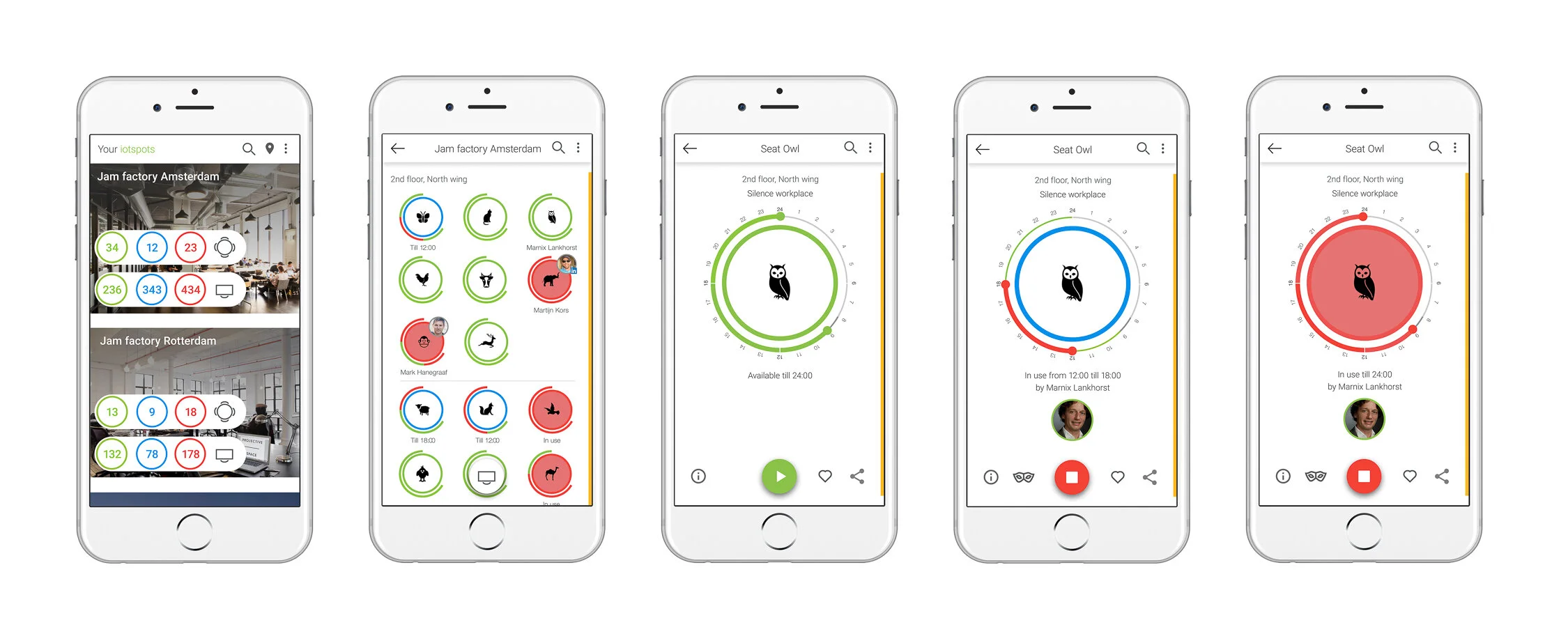
This data feeds into workplace platforms that help teams coordinate in-office days and, as a result, the occupants of smart offices get:
Better collaboration planning
Smarter space allocation
Reduced wasted real estate
At Amos Beech, we strongly believe in intentional hybrid work: people come to one of our offices when they need and for a specific purpose. In some cases, that means that everyone comes in every day, no exceptions.
In others, teams rotate or simply meet in the office when needed. The space should reflect each use case and be tailored to deliver a great end-to-end experience for both employees and office managers.
5. Adaptive Lighting Systems: Smart Offices that Deliver Comfort
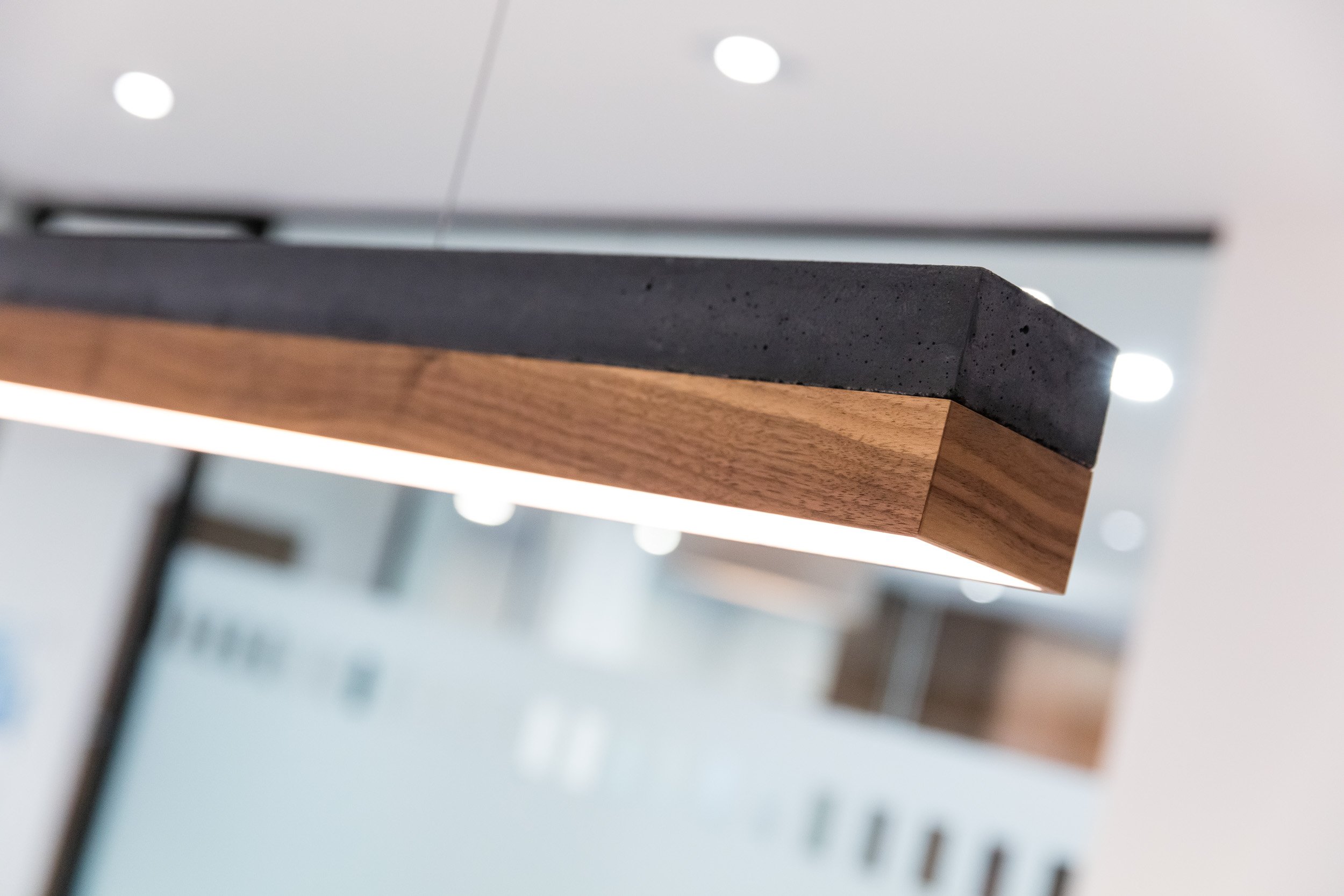
In a properly planned smart office, lighting becomes a responsive system rather than a fixed setting.
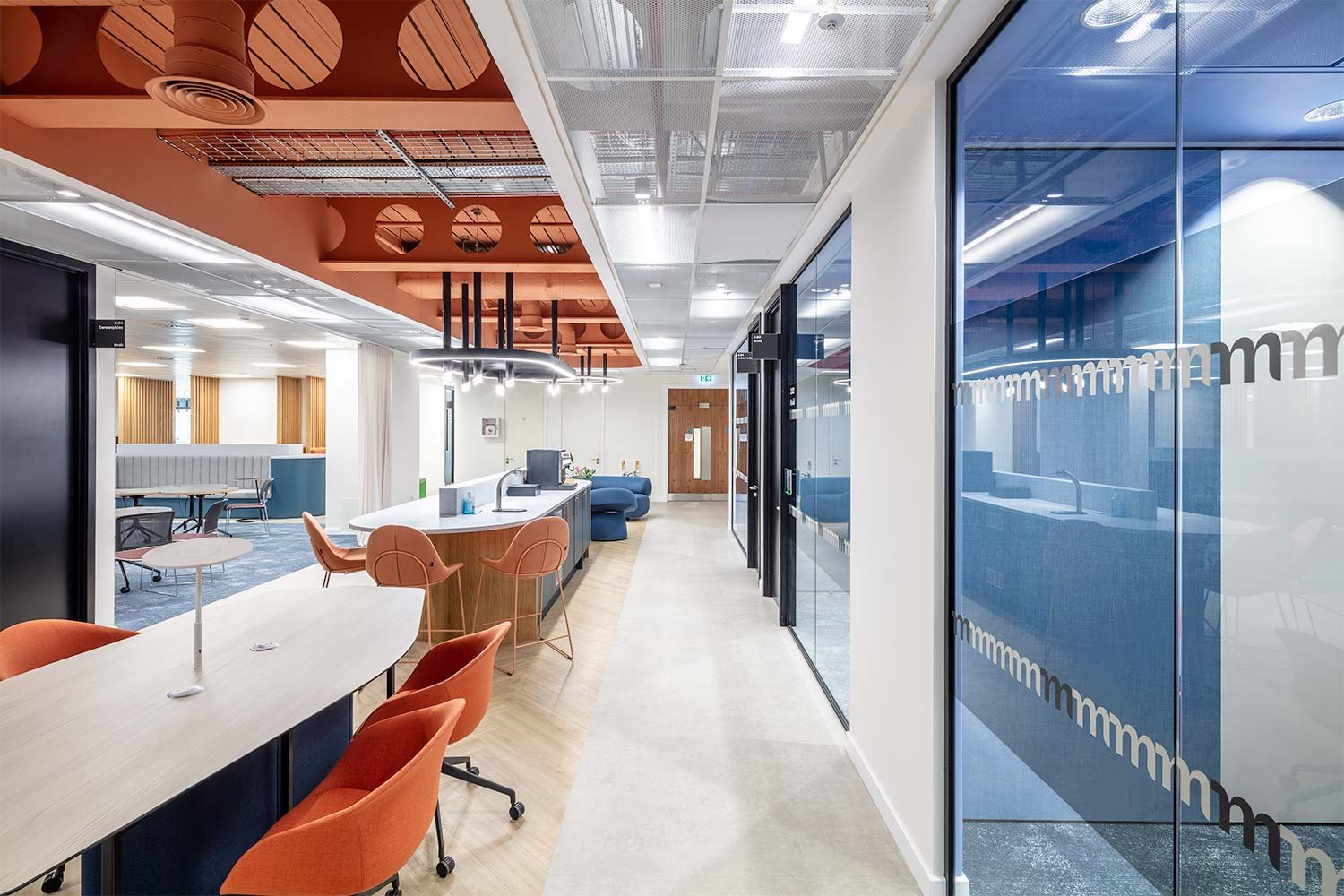
For instance, in some of the smart offices we designed in Glasgow and Edinburgh, we used sensors to track daylight levels, occupancy, and time of day.
The system adjusts brightness and colour temperature throughout the day to align with natural rhythms because south-facing spaces require a different response than interior zones and early mornings call for a different spectrum than late afternoons.
The impact goes beyond energy savings; it shapes how people feel and perform across the day.






6. Air Quality as a Managed Variable in Smart Offices
Office air pollution is a major concern across the UK, with the vast majority of employees complaining that the quality of the air in their workspace negatively affects their health and performance.
This is why, when we design a smart office, air quality moves into the same category as temperature and lighting: continuously measured and continuously adjusted.
Sensors monitor CO₂ levels, humidity, and particulate matter in real time. At the same time, ventilation systems respond dynamically, increasing airflow where concentrations rise and stabilising conditions across the building.
This creates a consistent indoor environment regardless of external conditions or occupancy fluctuations.
Better air quality supports concentration, reduces fatigue, and contributes to long-term health outcomes. It also plays a role in how people perceive the space: stale environments drain energy, while responsive environments sustain it.
7. Intelligent Meeting Environments Centrally Coordinated
One of the key components of any smart office is planning for the use of meeting rooms. We see it as an evolution from static spaces into coordinated systems.
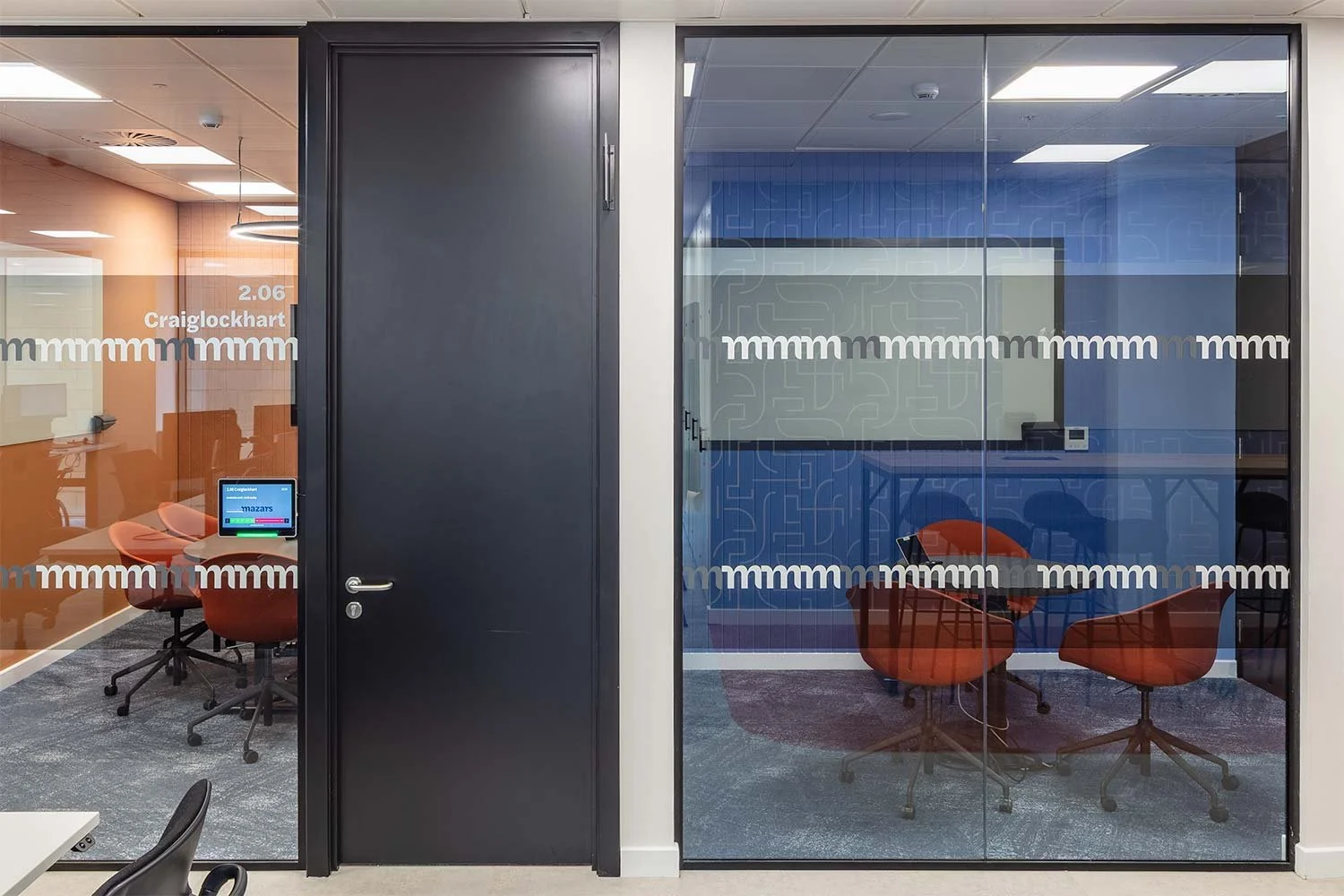
Occupancy sensors detect whether a room is actually in use, then booking platforms sync with calendars, and release unused rooms automatically. Integrated conferencing systems activate as soon as participants enter, with no setup required.
The system works because it understands intent: a booked room that remains empty gets reassigned and, thus, a team that arrives early finds the room ready.
This reduces friction across hundreds of small interactions each week and, if you’ve ever managed a team, you know that those minutes add up faster than most people think.
8. Space Intelligence and Continuous Optimisation
Did you know that offices generate data with every movement? Smart workplaces capture and use it.
Sensors and workplace platforms reveal interesting patterns:
Which areas attract consistent use
Where congestion builds
Which resources sit idle
In smart offices, facilities teams use this data to refine layouts, adjust capacity, and reallocate space.
Over time, the office evolves based on actual behaviour and decisions shift from assumption to evidence.
9. Integrated Access and Security Ecosystems
In most office buildings across the UK, access control is done via a simple badge swipe. In smart buildings, on the other hand, access control becomes part of a broader identity system.
Employees, visitors, and contractors move through the building using digital credentials. Permissions adjust based on role, schedule, and location. Entry points, lifts, and secure areas align with those permissions in real time.
The result feels seamless:
Visitors move through the building without delays, they don’t need to show their IDs at reception and waste precious time.
Employees access the spaces they need without manual intervention: no more DMs asking “are you using that meeting room at 3pm?”
Security teams maintain full visibility across all activity and they can pinpoint who’s where at any given time.
One of the most important changes in how we approach smart offices these days is proper integration: these systems do not compete for attention. Instead, they reinforce each other.
Lighting responds to occupancy data. Air systems react to the same signals. Meeting rooms, access control, and space analytics share a common view of how the building is used.
That shared intelligence is what turns a collection of features into a smart office.
All that being said, let’s address the elephant in the (smart) room: do you even need a smart office?
Why Smart Offices Matter Now
We’d love to tell you that everyone needs a smart office these days. In some ways, it’s true: beyond comfort, smart offices come with financial and environmental benefits that anyone can use.
However, we’re firmly against technology adoption for its own sake. Any technology you add to your office has to make sense for you and your workflows.
There are a few factors that influence the need (or lack thereof) for smart offices. Read through them to find out if they align with your situation:
Hybrid work complexity: your work no longer happens in one place at one time. Offices must support fluid patterns of use. Smart systems provide the visibility and coordination required to make hybrid work function.
Real estate cost pressure: office space ranks among the largest fixed costs for many organisations. The data-driven optimisation in smart offices reduces waste and improves utilisation without sacrificing experience.
Employee expectations: people expect workplaces to match the responsiveness of the tools they use every day. Slow, inefficient environments create friction, which, in turn, harms productivity. This is why we recommend smart offices especially to companies that are in technology or technology-adjacent fields.
Does a smart office sound like something your organisation could benefit from? Let’s find out how you can successfully implement it.
Implementation: Where Most Smart Office Projects Fail
In smart office design, technology is often the scapegoat when something doesn’t work. However, in our extensive experience, the failure point sits elsewhere.
Common issues include:
Fragmented systems that don’t integrate
Overinvestment in tools without a clear strategy
Lack of alignment between facilities, IT, and leadership teams
Lack of an overarching view: why do we need every piece of technology? What purpose does it serve?
A smart office requires a system-level view because each component must contribute to a shared objective.
This is where strategic design advisory becomes critical. Working with a design company that has solid experience in smart offices can save you hundreds of thousands of pounds and many, many headaches.
The Role of Strategic Design in Smart Offices: How We Approach it
Designing a smart office isn’t a simple matter of selecting vendors. Sure, they matter, which is why Amos Beech only works with vetted vendors who provide reliable and tested solutions. But the core of a good smart office design is defining how the workplace should function.
That includes:
Mapping employee journeys through the office
Identifying friction points
Prioritising systems that remove those frictions
Ensuring interoperability across technologies
At Amos Beech, we approach this from a performance perspective. The goal is not to install technology but to improve how the organisation operates through its environment.
Measuring Success: What Our Smart Office Design Solutions Deliver
A smart office should deliver measurable outcomes.
When we measure our success, some of the key metrics we analyse are:
Energy consumption per square metre
Space utilisation rates
Maintenance costs
Employee satisfaction scores
Time spent on operational tasks
When implemented correctly, improvements show up across all five.
Need Similar Results?
There is a reason why we are one of the UK’s preferred workplace consultancy and office design companies: we’ve been in this industry since 1990. We couldn’t have held our ground in such a competitive market for nearly four decades if we didn’t value results first and foremost.
At Amos Beech, we believe in personalisation and custom projects, not just in the sense that we will give you a custom quote (although that’s true). We approach every project with the clear aim of turning an office into the space its occupants need, whatever that may mean.
Want to know more about our approach to smart office design? Reach out for a free, no-obligations consultation: